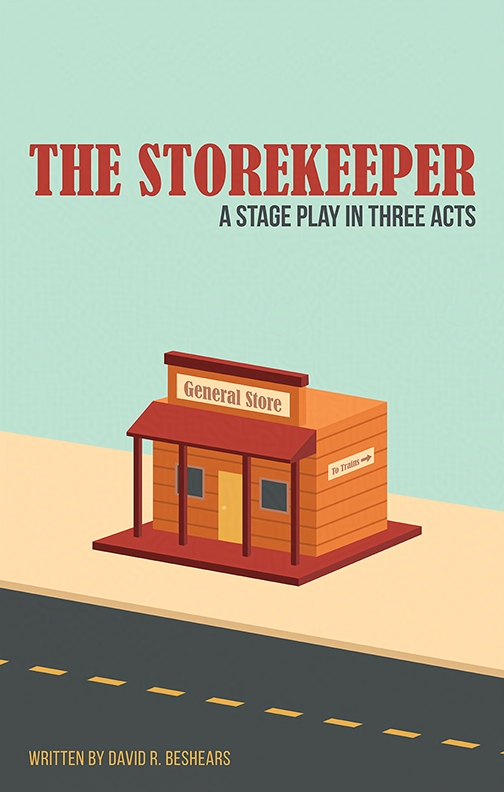
David Beshears’ play The Storekeeper brings a Twilight Zone-inspired mystery to the stage, following a group of strangers who arrive at a remote general store with no memory of how they got there. Originally written as a novella, Beshears adapted it for theater, emphasizing eerie atmosphere, dynamic dialogue, and suspenseful storytelling. With its moody setting and unanswered questions, The Storekeeper keeps audiences guessing until the very last moment.
Script Spotlight
“You're traveling through another dimension, a dimension not only of sight and sound but of mind. A journey into a wondrous land whose boundaries are that of imagination.”
It’s hard to say how many people are still familiar with that weekly introduction to The Twilight Zone, a beloved black-and-white mind trip of a TV show from the early 1960s. David Beshears remembers the show, and he mentions it as a clear influence on his science fiction and fantasy work.
That goes double, maybe, for “The Storekeeper,” in which a diverse cast of characters arrive at an old general store in the middle of nowhere with little memory of where they’ve been or where they might be going. The title character seems to know more than he’s letting on, and he’s in no hurry to explain himself.
We had a few questions for David, and he gave us a few answers. Welcome to The Spotlight Zone.
You have written quite a few science fiction and fantasy books. How many plays have you written, and what inspired you to do so?
I had already written an early draft of “The Storekeeper” as a novella when I ran across a copy of the original stage play of “Inherit the Wind.” While the story and structure of the two are nothing alike, it got me looking at “The Storekeeper” differently. I noticed that the story lended itself very well to the stage.
I am now looking at adapting several of my other titles that also lend themselves to the stage, both one-act and three-act. Quite exciting.
What’s a key difference between writing a book and writing for the stage?
For me, it was moving the inner voice and narrative out to dialog and physical presence, and making it seem natural and credible. It also requires bringing seemingly disparate locations down to three sets, all while not making it claustrophobic.
What was the inspiration for “The Storekeeper”?
Many of the characters in my books often take on existences of their own. How can I bring them together into a single story? More importantly, how and where can I give them presence and futures of their own?
Have you ever seen this play performed? If so, how did it go?
Scriptmore is the play’s first exposure to the outside world, though the literary novella adaptation (multiple book formats) has been well received.
“The Storekeeper” holds on to the mystery about what’s going on for most of the play. Do you have any favorite plays that keep audiences (and the characters) guessing until the final moments?
If you consider the original The Twilight Zone as a series of plays, then yes.
Any advice for a director about how best to stage this play?
While the play has three very distinct sets, one per act, each act has two unique scenes. I would recommend using transition, mood, and lighting to enhance the sense of moving the story steadily forward across the six individual sections rather than three.
Oh, and do what you can to give the play the moody atmosphere of [drum roll] … The Twilight Zone.